Free Express $149+ (AU), more countries…

A bottle of fountain pen ink costs about $10–$40.
That might sound expensive for something you write with, but fountain pen ink is surprisingly economical: a 50mL bottle can give you roughly 1,000–2,000 A5 pages of writing.
In a fine nib, that's about ten notebooks worth or 5 pages a day for a year.
And you don't need to buy a giant bottle to get started. Plus you can also use cartridges, which are cleaner and easier if you're new to fountain pens.
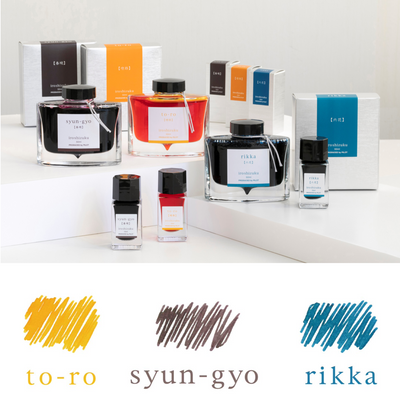
Most ink brands offer more than one way to buy. Here's an example for one of our most popular brands, Pilot Iroshizuki: 
What the table shows is that bottled ink can cost several times less per mL than cartridges. Cartridges are convenient, but bottles are economical. The cost per mL is also less for standard washable inks, and more for the boutique ranges with their heavier loads of dye, shimmer or pigment.
Knowing the capacity of your pen will also guide your ink buying decisions. A typical ink cartridge holds 0.7mL, a converter 0.5-1mL, while a larger piston-filled pen can hold 1.5–2mL. Smaller ink capacities may suit frequent ink colour changes, and larger capacities are more often used by people who like to stick to just one ink.
Nib size will also impact how much ink you use. Medium and broad nibs increase ink usage two to three fold compared to narrower nibs. Most people start with a fine nib (or medium in Japanese brands), but might also become interested in broader nibs for short bursts of more expressive writing
This is the real fear of bottled ink.
And yes, you can make a mess if you hold an open bottle in one hand, and wave your fountain pen around with the other. But filling doesn't have to be messy.
Choose an ink bottle with a stable design and a wide enough opening to easily fit your pen. For cartridge-converter pens, you can also use a blunt syringe to fill the converter without putting the nib into a bottle.
Sit at a table to fill your pen, and use a tray or a paper towel to contain occasional spills.
Modern fountain pens are much safer than their reputation suggests, but some will handle rough treatment better than others.
For all pens, carry them with the lid on and tip up. For pockets, there are some pens intentionally designed to a shorter length.
For travel, cartridges are the simplest option because there's no bottle to carry, and you can take a spare cartridge with you.
Some cartridge-free pens have safety features as a way to help you in the air. The Pilot Custom 823 includes a shut-off valve between the ink reservoir and feed. Close the valve and you can isolate the ink supply from the nib. This is how most vacuum filling and eye dropper style pens are designed.
For fountain pens without a valve, carry them as hand luggage, either empty or completely full. It's the air in the pen that expands and can accidentally push ink into the cap.
You don't have to commit to a large bottle of ink and a complicated filling ritual. And although most people take their pens everywhere, you can use yours just at home.
Start with the cartridge that's compatible with your pen or a small bottle of ink. If it's a cartridge pen, you need the compatible converter to draw up the bottled ink. Once you discover a colour you love, move to a larger bottle.
$149.00 away from free shipping!
{"one"=>"Select 2 or 3 items to compare", "other"=>"{{ count }} of 3 items selected"}